performances
24 February 2026
Bozzini Quartet; Kings College, University of Cambridge
Loading audio peaks...
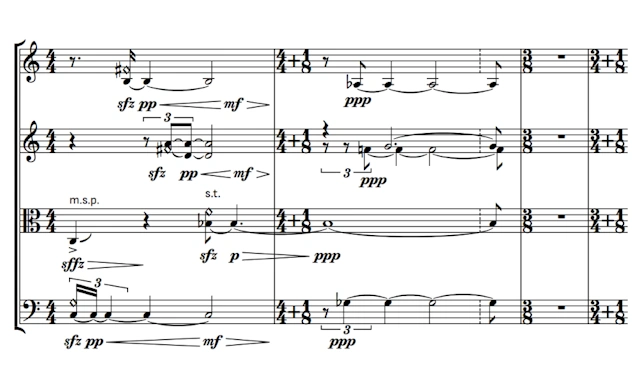
Score excerpt
flotsam / jetsam (2026)
for the Bozzini Quartet
string quartet
/
7'
The initial inspiration for this piece came from Alex Ross’s article ‘The Composers of Quiet’ on the Wandelweiser Group, in which he contends that John Cage ‘generally allowed tonal materials only as meaningless flotsam and jetsam’ (by contrast, Wandelweiser composers such as Jürg Frey and Eva-Maria Houben are said to display unstable ‘ghost tonality’, ‘free to dwell on a sweetly consonant interval or chord’). In this work, I question the intentionality in the metaphor of ‘flotsam and jetsam’ – literally cargo or debris that has floated up from a shipwreck and goods intentionally jettisoned from a vessel to prevent wreckage, respectively. Both are consequences of tempestuous conditions at sea – unintended, as such – but describe human, unnatural objects which have intrinsic design and intentionality; they are out of place and isolated. I was extremely fortunate to have this piece workshopped and performed by the Bozzini Quartet (they have worked closely with Frey and Edition Wandelweiser), who provided invaluable insights into performance practicalities and notation.
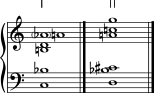
The piece is divided into two discrete sections, which can be thought of as ‘flotsam’ and ‘jetsam’, in that order. I explore different formal techniques to create expressive quasi-organic results. Both are constructed formally using a different hexachord (see below), although in the first movement, the sixth pitch is withheld for most of the piece. In ‘flotsam’, the compound sonority slowly unfurls, with the perception of time shifting as though affected by gentle waves in the aftermath of a storm – as if different objects periodically bob above the water. The hexachord is transposed and octave-displaced, using a variety of contrasting textures, although the constant gentle oscillation never entirely disappears. The second movement is more violent, with a propulsive rhythm, taking a slight inspiration from Beat Furrer’s spur and the music of Stefan Wolpe. The hexachord does not assume octave equivalency: instead, I am concerned with rigorous intervallic rotation (where stacked intervals are shifted around), and the pitch material is further defined by the absence of two pitches, D♯ and F♯. The piece is centred around the pitch D, which is held in one part at a time, each rupturing into a new rotation representing a new set of objects rising to the surface – more vigorous each time. Eventually, the piece dissolves into a quiet resonance where the pitch material is naturalised – played in natural harmonics (differing from equal temperament – especially in the case of the seventh and eleventh partials) symbolising the absorption of the jetsam into the ocean mass. In my previous work, oceanograph (2024), I have also explored formal processes such as intervallic rotation to represent the chaos and boundlessness of the ocean – with an interest in cases where nature overpowers humanity.